
The interview got canceled a couple of minutes before it started
I got invited to a tech interview. The vacancy was for a Vue developer. I sent a cover letter in DMs, and right away – a call with a test task, nobody asked for a résumé. Later the meeting was moved from Friday to Monday because of the interviewer's work stuff; with the time I'd won – and, by a lucky coincidence, having fallen ill on Saturday – I spent the whole weekend closing gaps in my knowledge so I could get through the review confidently and professionally. On Monday, a few minutes before the call, he asked me for my CV. I sent it, and the interview was canceled: they need three years of experience or more. I have less.
The interviewer himself admitted he should have asked in advance, and apologized. I replied calmly, but the weekend of prep went down the drain – it stung a lot, and consoling myself with the fact that I'd picked up new knowledge anyway didn't really help. To put these emotions somewhere, I went to a webdev chat. The conversation there drifted to AI, and I wrote a long message about why I love frontend and how it gets devalued. I started with why I like this niche so much.
Frontend as the work of reconciling other people's requirements
I really love this profession. I love it because you have to bring everyone's requirements together at once. In a sense, a syncretic craft, if I can put it that way. Backend, business, users, designers, managers – a frontend dev keeps all their wishlists in their head at the same time. Plus CI/CD, tests, security, speed, maintainability, which the frontend dev has to take care of.
Speed is a separate conversation. In his annual review "The Performance Inequality Gap, 2026," Alex Russell writes that the cheapest phones haven't seen any noticeable CPU speed gains since 2020, are roughly 9 times slower than fresh iPhones in single-core performance, and the amount of JavaScript on mobile pages has more than doubled since 2015. Fewer than half of sites pass Core Web Vitals for mobile users. So the benchmark is basically a f*cked-up 2015 MacBook, and everything has to at least somehow work on it too.
Data and chart: Alex Russell, "The Performance Inequality Gap, 2026." Black line – iOS, light grey – Android, dark grey – budget Android, orange – low-end devices.
At the scale of micro-teams – outsourcing, freelance, maybe small studios – a frontend dev de facto has to cover the roles of product person, designer, architect, DevOps, sometimes even the backend devs themselves – everyone who isn't on the project. That's how it was for me on our shared product. Maybe I'm romanticizing the industry, but it's great! Really great. You don't become a replacement for a lead Go developer at Yandex, and you don't have to master all of it, but you're obliged to at least understand their pain and be able to cover it.
Who's to blame for all the sins
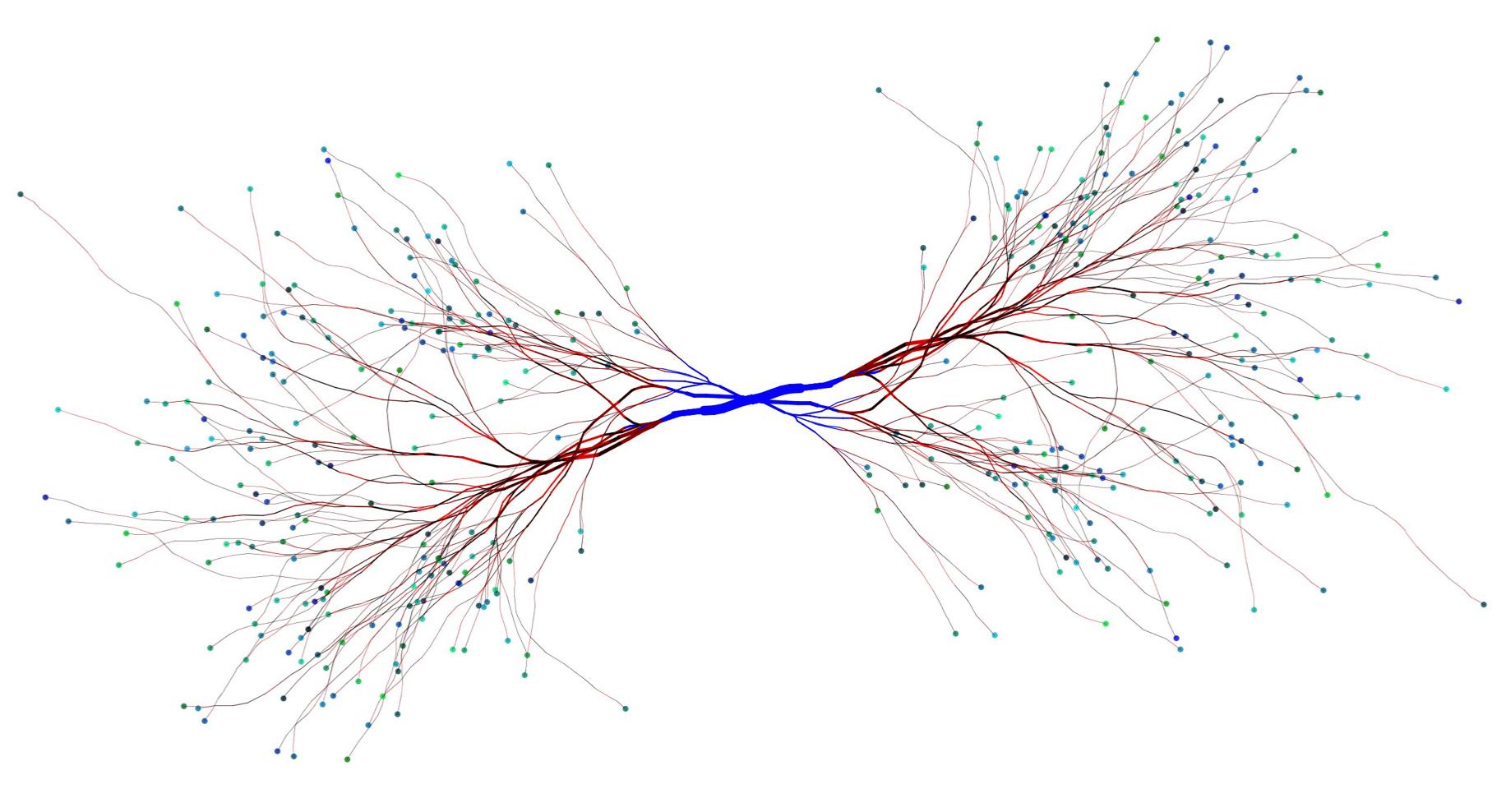
My dear backend friend, whom I love with all my heart, seriously underestimated frontend until we started working closely on a shared product. Somewhere around the middle of the process, he saw the scale of the disaster. What changed his mind was that frontend can't be boiled down to either markup or genAI: an interface has to work for everyone, handle a ton of requests from the backend, do some computations on its own side, process user actions, be maintained, extended and secure. The clearest marker of complexity was probably the constant Discord calls to discuss decisions, decisions, decisions – giving birth to ever new non-trivial outcomes for trivial tasks.
Scrolling through Reels on Insta* from time to time, I kept running into backend devs in the comments claiming that with a neural net they'd cover both their own work and the front, which means frontend devs aren't needed by anyone and anyone can become one anyway. Based on my purely personal observations and serious, completely unsupported analytical breakdowns, they themselves have probably never written frontend by hand.
At my previous organization, I got to hear that a web developer can be replaced by a neural net – you just have to hand it to a rank-and-file markup coder. That's someone else's view, and I won't judge it. But in general, frontend responsibilities are more and more often reduced to executing assigned tasks: judging by vacancies at big companies, this role has noticeably less authority and freedom.
The dissonance of outward simplicity is probably reflected most vividly in old but still relevant debates. In the essay "The Great Divide" (2019), Chris Coyier quotes Mandy Michael: she's surprised that "just writing JS" is considered normal, while "just writing HTML and CSS" isn't enough. In her words, until every new site is perfect in semantics, accessibility and responsiveness, it's too early to devalue these languages. So, on the one hand, people try to reduce the profession to a simple craft, and on the other, the demand for interface quality keeps getting more and more colossal.
As a result, the poor frontend dev brings together the requirements of all sides, which means it's in his work that you can see where those requirements went off the rails – a crooked mockup, a crashed prod, unrealistic business wishlists – the user or the manager will notice it in the interface and that's where they'll go looking for someone to blame. The site won't load – blame the front. The back sent the wrong thing – blame the front. The release slipped a week, the dollar dropped, the office ran out of coffee – of course, it's the usual suspect. The frontend dev, that is.
The great and terrible AI actually helps
Let me make a disclaimer right away – neural nets really do speed up and automate a lot, many times over, and I'm not against AI thingies. With them I've managed to solve very specific tasks and speed up my work, and after all, I learned GSAP from little tasks Claudie gave me.
Being a staunch AI opponent these days is just weird – at least if development is your profession and not a true-hardcore hobby.
And the numbers, by and large, back this up: according to the Stack Overflow developer survey (2025), 84% use or plan to use AI thingies, and 44% have used them for learning. This can be explained – honestly, I never got around to studying the reasons for this trend, so I'll just guess: the competitive environment presses, business asks, plus it's convenient and generally hyped. So, fine, okay, but are we really winning from such mass adoption?
Data: Stack Overflow Developer Survey 2025, AI section. The first four bars add up to that very 84%.
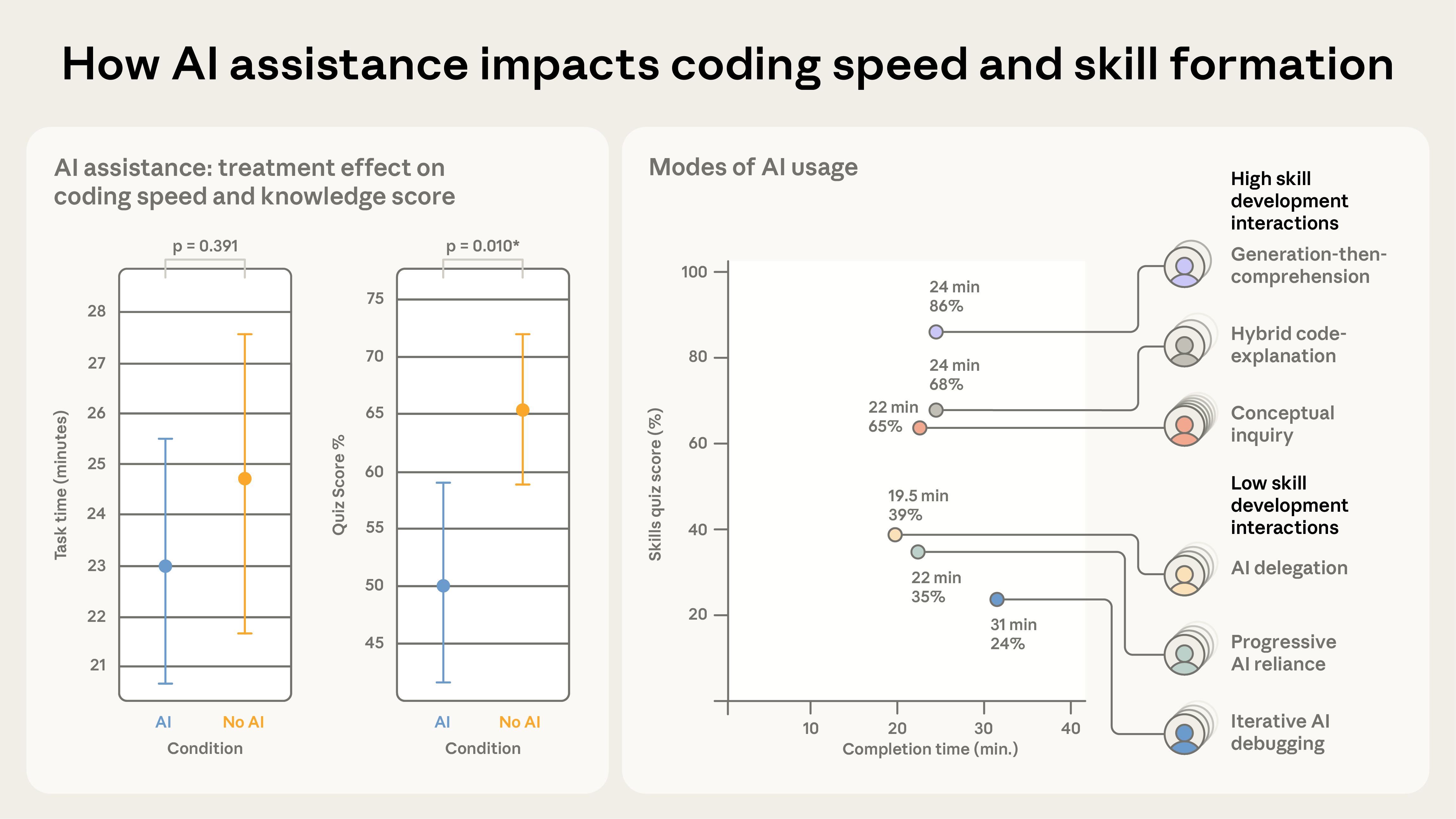
I had the same question. And I found an answer! In an Anthropic experiment (2026) with 52 developers, the AI group scored on average about 50% on a comprehension test versus 67% (six seven) for those who wrote code with their own little hands. While reading, the most unexpected part was that the time gain turned out to be statistically insignificant. Those who asked the little model conceptual questions or asked for explanations scored 65% and higher, while those who handed the assistant literally all the code scored under 40%. I'll just clarify that the experiment measured learning a new library, not programming in general. But it does show the problem with vibecoding – when you fully delegate, you get code you don't understand. And that's critical.
Data: Anthropic, "How AI assistance impacts the formation of coding skills." Group values are the thresholds reported in the study.
Neural net fails are where the profession gets most interesting
So why is it critical, anyway? There's a whole list of things where the AI thingy stalls one way or another – probably the unifying word for most examples, from wonky responsive layouts to some super-unique "not like everyone else's" design that's by no means glued together from Dribbble pins from ten years ago, would be contextuality. Not in the sense that the neural net supposedly doesn't understand the product's technical specifics, the influence of other files or run-of-the-mill shitty code – agents closed that gap long ago and effectively; most solutions are reusable and depend little on what and how things were done on your side, which the AI thingy has been actively exploiting, pretty much from the very start – the training data didn't come out of nowhere. I'm talking about contextuality in a completely different, purely human sense.
You see, a project is the product of human decisions and constraints, ultimately made by people for people. I won't drag on about artificiality or drift into abstract philosophy – every product has a past full of compromise decisions, a boss who needed it yesterday, a client with their own quirks, legislation, and just plain raw mockups that someone later has to test in tears... Basically, it's the same work I love the profession for. And the promise of those anons from Insta* to "cover the front with a neural net" runs straight into this part – even dry generation, in the end, needs validation, which in turn needs a trained eye and experience. And they don't have them. Not your average backend dev/designer/manager/vibecoder/insert-your-own. I wouldn't dare throw shade at developers higher up the hierarchy: they're awesome, simply the best, no complaints, please hire me.
Speaking of validation, by the way – according to the same Stack Overflow survey (2025), 66% of respondents complain about AI thingies' solutions that are "almost right, but not quite," and about 45% – that debugging generated code takes more time.
Data: Stack Overflow Developer Survey 2025, AI section. Multiple answers allowed.
The almighty AI multiplier
All of this was said to lead up to an idea I worked out for myself and then very luckily found in the DORA report (2025), based on a survey of almost 5,000 professionals: AI is a multiplier. It amplifies the inputs many times over but doesn't change them – the mediocre becomes hugely mediocre, the good becomes hugely good. If we throw specialists out of this equation and leave only the mediocre, and without any corrections to boot – we'll get nothing but an imitation of a product, made for who knows whom and for who knows what purpose. I think that's roughly how all those memes about your very own "Vibecoded B2B B2C C2C AI-Driven SaaS" came about. It's bordering on a cargo cult.
What happens when the price war ends
Cheap is never forever. Well, I'd like it to be, of course, but I haven't seen any examples yet. Let's put it this way – the money we pay for tokens and subscriptions right now is plain price dumping. All these huge corporations are literally burning billions of investor money and resources in the heat of their battles for market share. On the plus side – we get services far cheaper than their real cost. On the minus side – first, it won't last forever, second, go check RAM prices – they'll unpleasantly surprise you. So when vendors want their super-profits, the market will face a dilemma – what's more cost-effective: paying for the neural net at its real price, or hiring a specialist after all?
And there are signs of this already – the whole take is still just my IMHO, but, for example, as of June 1, 2026, GitHub switched Copilot to billing by actual token consumption, saying outright in its blog that it's a step toward a sustainable business model.
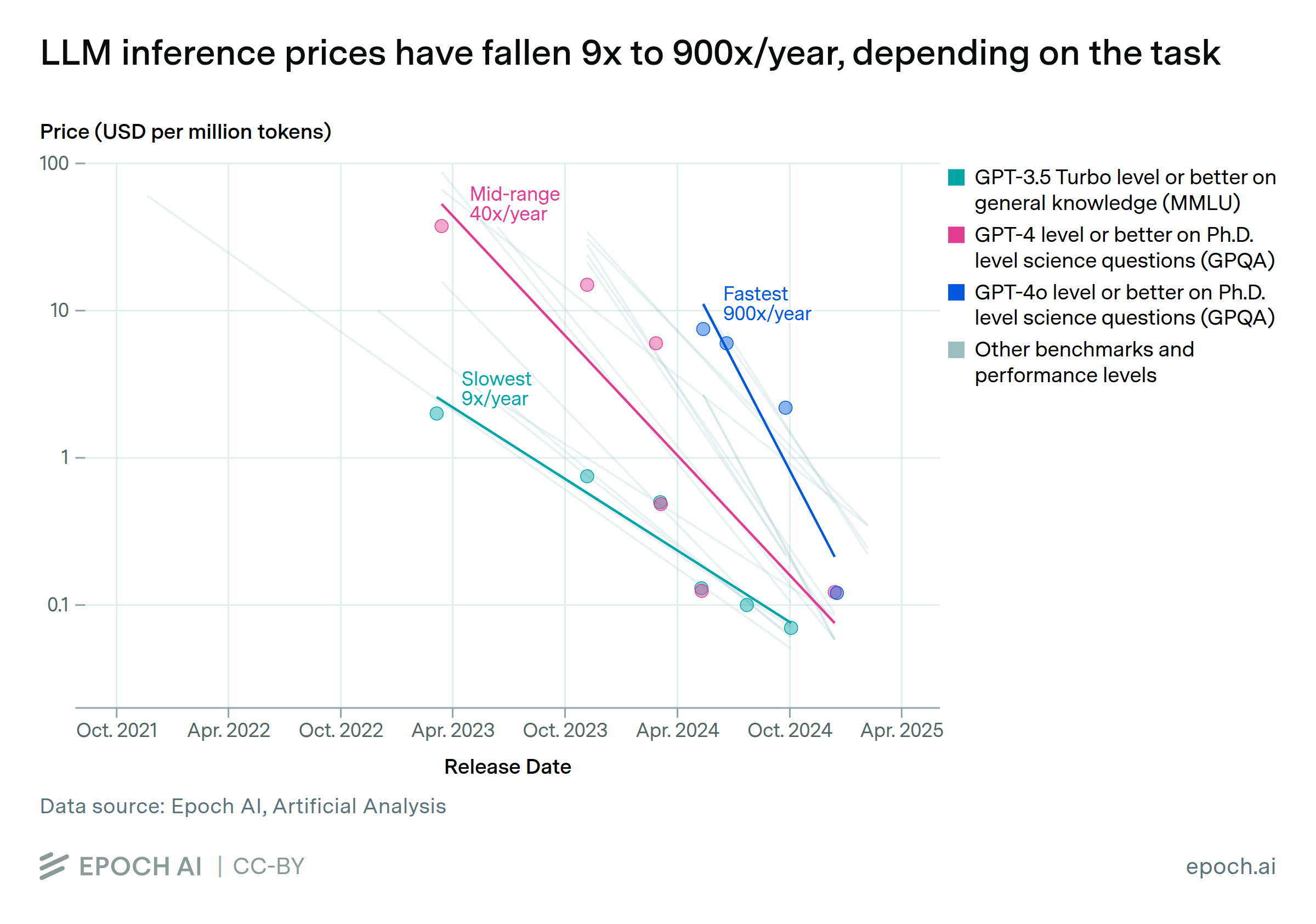
Someone might object, of course – look, according to Epoch AI reports, the price of the same level of quality has been dropping almost dozens of times over per year – models get cheaper, polished, optimized, hardware too, so what's the problem?

And, like, yeah, the quality level from, say, '23 really is starting to cost pennies. But who needs it now? Does anyone even remember the top models from back then? Personally, all I remember from '23 is Will Smith eating spaghetti. You can drag Jevons paradox into this – the cheaper and more accessible a resource becomes, the more it gets used. One agent trying with all its might to come up with an elegant solution on a legacy codebase from 2012 devours as many tokens as a chatbot burned through in a week a year ago.
That's probably why the market is gravitating more and more toward developers who know how to work with neural nets – it's hard to overestimate the AI thingy's impact, but going to extremes like autonomous vibecoding or a staff of true Gentoo purists won't lead to anything good, neither now nor, by the looks of it, in the future.
The market has spoken
I won't even dare deny that half of this article is an attempt to justify to myself the value of my work and my irrational love for it, but I think there are quite a few developers who feel the same – I hope I managed to convey these feelings.
Finally, I guess I want to vent about the situation on the market. Whine, to put it simply. You open hh.ru, HireHi, Talanto, GeekJob, Habr (Russia's biggest IT community, with its own job board) – anything, really – and there are incomparably more full-stack vacancies than pure frontend ones. Market crisis, oversaturation with new developers, frontend being underrated among other things – no business wants to take on an unjustified risk at a high price, and I get them; and in general, rotating the same specialists between companies and hunting for unicorns is way easier than onboarding and training a newbie. But it turns out juniors and middles don't get hired – Zerocoder (a Russian online IT school) says there are about 21 résumés per entry-level frontend vacancy. I've already gotten the "three years or more" requirement. And salaries are going down, of course.
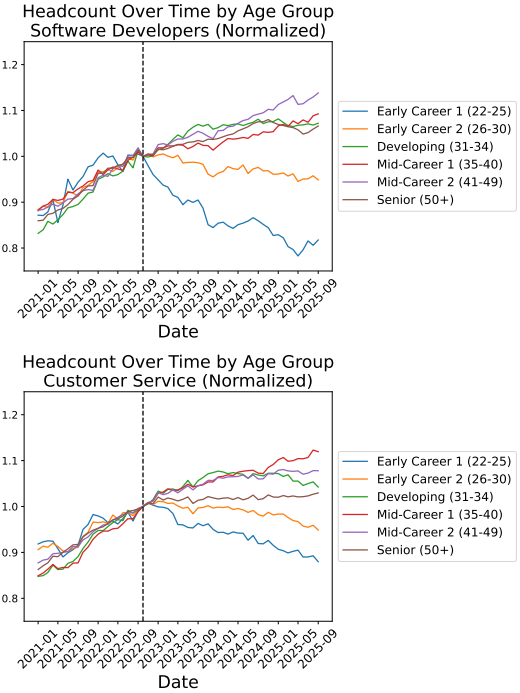
The Stanford Digital Economy Lab confirms this on an international scale: by July '25, employment of developers aged 22–25 in the US had fallen by almost 20%, while for more experienced ones at the same shops it stayed stable or even grew. The August '26 update says the same thing – employment of young workers in the most AI-exposed occupations is 19% below the expected level, mainly due to reduced hiring. They link this to the fact that newcomers' tasks are based on codified knowledge that neural nets can cover, while experienced workers rely on experience and judgment.
Frontend dev, don't sell yourself short

I love this profession. Really. I never felt it in the moment, but every time I found out after the fact. At some point I just realized I can't live without all of this.
And it's not about idealism or a love of code – I'm not a fanatic about getting lost in writing code at all. Frontend hooks you precisely because it teaches you to climb into other people's heads: to reason like a designer, think like a product person, understand the pains of DevOps, the architect and the backend dev. It's a school of decision-making in the chaos of development, because, as a very close friend of mine said, "in an ideal world it would be like this, but in reality, of course, everything's harder." There are loads of other niches and professions that demand the same flexibility and multi-role-ness, and I'm not ruling anything out: it's quite possible that over time I'll move into product management or leave for something outside IT altogether.
But right now I'm here. With all my gaps, fears, sleep-deprived weekends and failed test tasks.
The devaluation of our work is a strange thing. On the one hand, this wild market conviction that frontend is "simple" really does break hiring and salaries. On the other – you look at all these attempts to replace engineers with an AI thingy and realize how detached from reality it is. I can't change this mindset on an industry scale anyway, and I'm not trying to. The only thing within my power is to do my work so that the real result speaks for itself. And to those who still sincerely believe that the front gets covered in a couple of prompts – just take a look at this work from the inside. The way my backend friend from the beginning of the article did. No reproach, no posturing – just give it a try, it's a useful experience, I promise.
And to those who've made it all the way down here, one last thing: my dear, don't sell yourself short, you matter, and you've got a great craft. Hugs, all the best.
* Meta Platforms Inc., which owns Instagram, has been designated an extremist organization; its activities are banned in the Russian Federation.
No comments yet.